Tag: Braces

Your Child’s First Check-up

Your Child’s First Check-up

Choosing The Optimal Time For Treatment

While orthodontic treatment most often begins between the ages of 9 and 14, some orthodontic problems are easier to correct if they’re treated early.  If it appears that treatment will be needed, your orthodontist can advise you as to the ideal time to begin and should be evaluated by the age of 7.  This gives your orthodontist the best chance to:

  • Guide jaw growth
  • lower the risk of trauma to protruded front teeth
  • Correct harmful oral habits
  • Improve appearance and self-esteem
  • Guide permanent teeth into a more favorable position
  • Improve the way lips meet

kidbraces3


Signs Your Child’s Bite Isn’t Right

It’s not always easy to tell when your child has an orthodontic problem.  Even teeth that look straight may be hiding a problem bite.  Here are some clues that may indicate the need for Orthodontic attention:

  • Early or late loss of baby teeth
  • Difficulty in chewing or biting
  • Breathing through the mouth
  • Thumb-sucking
  • Crowded, misplaced, or blocked-out teeth
  • Jaws that are to far forward or back
  • Biting the check or biting into the roof of the mouth
  • Protruding teeth
  • Upper and lower teeth that don’t meet, or meet in an abnormal way
  • An unbalanced facial appearance
  • Grinding or clenching of the teeth

kidbracesheadgear

About Orthodontist

Orthodontist are dental specialist who diagnose, prevent, and treat dental and facial irregularities.  They receive an additional two to three years of specialized education beyond dental school to learn the proper way to align and straighten teeth.

kidbraces2

Give Your Child the Gift of a Healthy Smile

Not only do well-aligned teeth look good and feel good, they also are important to good dental health.  Poorly aligned teeth can lead to dental problems.  Not everyone needs orthodontic treatment.  But if your child does need help, it pays to start treatment when you have the greatest chance for success.  Make sure your child receives an orthodontic check-up no later than age seven.


The Exciting New World Of Accelerated Orthodontics

The Exciting New World Of Accelerated Orthodontics

The Orthodontic world is rapidly changing. One of the major changes is the introduction of accelerated Orthodontic treatments.  Treatment times have already been cut to half of what they were just  two years ago.  This has been achieved by accelerating our natural cycles that allow teeth to be moved through orthodontics.  Some patients can be treated in as little as six months with Invisalign therapy or traditional braces!


The bone that houses the roots of our teeth have a natural recycling process called the osteogenic cycle. This involves two bone cells called osteoblast and osteoclast. Osteoblast synthesize bone, and osteoclast break down bone tissue.  This function is critical in the maintenance, repair, and remodeling of bones in our body.  Essentially, our bones are in a constant state of recycling.  Applying consistent pressure to a tooth causes  the bone around the tooth to adapt and allows the tooth to then move with the pressure provided by either Invisalign trays or traditional braces . osteodiagragm
Accelerated Orthodontics is achieved by increasing the production of these special cells in our body causing the process to double in speed as well.   The early stages of this acceleration were only able to be achieved by surgical means.  Patients would see a specially trained periodontist or oral surgeon who would perforate the bone with a drill and the healing process would cause an increase in cellular production.  The down side to this option is the discomfort associated with surgery as well as the cost due to the large amount of time the surgery takes the specialist.


Thankfully this new science has entered into a new phase. By inserting a mouthpiece fitted around traditional braces or Invisalign trays and wearing the activator every day the Orthodontist at West paces Ferry Orthodontics can speed up tooth movement through the use of vibrations.  This increases blood flow in our upper and lower jaw and this in turn increases the production of the osteoblast and  osteoclast, causing the bone to remodel to the tooth’s new position much faster. This also decreases the inflammation caused by orthodontics lowering the level of discomfort as well as speeding the process up.

Invisalign or Traditional Braces


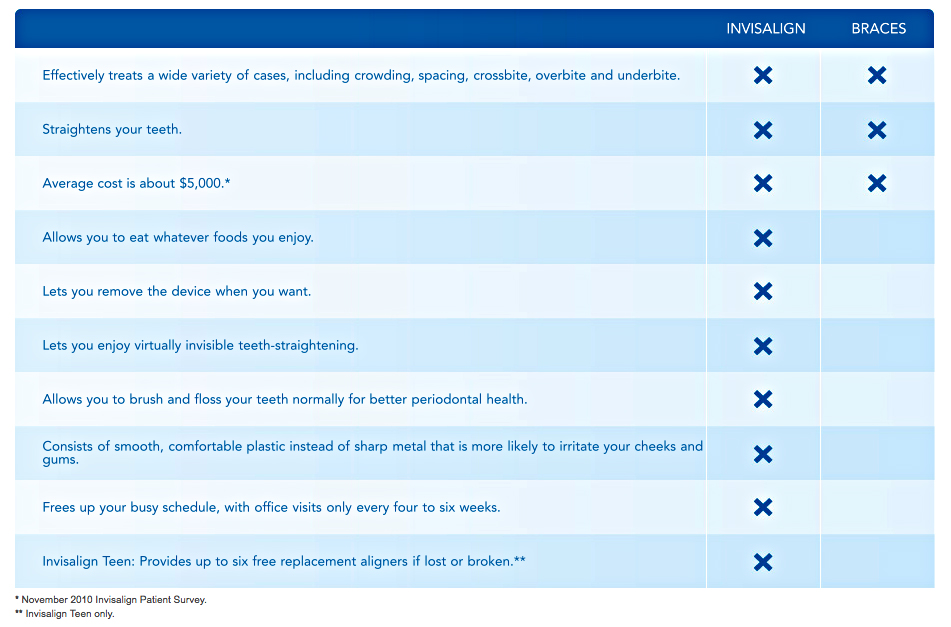
Traditional braces may not be the best option for the business professional in the busy world in which they operate in. Considering braces versus Invisalign to straighten your teeth may lead to a lot of questions. Which is more effective?  Which is more affordable? Which is better for my overall dental health? Both braces and Invisalign were designed to straighten teeth while improving your smile and oral health. Braces consist of metal or ceramic brackets that are glued to your teeth, and connected via wires and tiny rubber bands. Invisalign, on the other hand, is designed to be invisible. Aligner trays made of smooth, comfortable, BPA-free clear plastic are worn over your teeth to subtly and gently move your teeth.

The first question for many potential patients is how effective is Invisalign in comparison to traditional bonded braces.  Let’s start by reframing the question. As a potential patient, the most important question to ask when considering your treatment options is what will work best for me?1This answer is different from patient to patient because individual needs and habits greatly affect the final outcome of treatment. In the past, some conditions were more difficult to treat with Invisalign, but with technological advancements and the expertise of the practitioner (West Paces Ferry Orthodontics is a Top 1% Elite Provider – the highest level of classification Invisalign offers) most, if not all, of these concerns have been addressed and improved. But, as mentioned, Invisalign is not for everyone. For example, one has to be vigilant in wearing their aligners. The temptation to take them out too often or not wear them enough is too much for some.braces-vs-invisalign

Of course cost is a concern as well. Prices of treatment vary greatly from patient to patient based on the needs and goals of the individual patients. Not only that, but prices vary greatly from provider to provider. In some practices, the price is fairly close to traditional braces as the provider has acquired the skill to complete the treatment without incurring higher cost in doing so (which is the case at West Paces Ferry Orthodontics) while a provider that has not completed as many Invisalign treatments may need more time and resources to achieve the same outcome resulting in higher fees.

Also, one must consider the effect on our overall oral health. Invisalign tends to have an advantage here.  Fixed orthodontic appliances (FOA) temporarily interfere with periodontal health of patients, as the appliance complicates oral hygiene. The use of aligners in orthodontic therapy increased strongly during the last decade. In the literature, the reports about effects of aligner treatment on oral hygiene and gingival conditions are scarce 2.   The fact that Invisalign can be removed for brushing and flossing give Invisalign a significant advantage. This allows the patient to clean plaque away from the enamel and gingival surface with much less effort. The plastics do not contain BPA and are registered and approved by the FDA.3


Sources:

Invisalign.com

  1. http://docbraces.com/2014/01/works-best-invisalign-vs-braces/
  2. http://www.medscape.com/viewarticle/847508
  3. http://www.accessdata.fda.gov/scripts/cdrh/cfdocs/cfRL/rl.cfm?lid=6122&lpcd=NXC